

What actually gets through a filter bubble?
Why facts don’t work (and what does)

It seems the more we ramp up urgent facts, graphs, reason and even compelling stories, the more the algorithm works against us and shuts us out. Polarisation feels worse and the same arguments loop endlessly within the same groups.
I’m writing about climate communication here but the learning stacks up for any topic.
To understand why, let’s dig deeper into echo chambers, filter bubbles and identity boundaries and figure out how to burst, join or penetrate them.
Echo chambers and filter bubbles
An echo chamber is social. It’s who you follow, trust and talk to. People like you, with values and identities that feel familiar.
“An environment in which a person encounters only beliefs or opinions that coincide with their own, so that their existing views are reinforced and alternative ideas are not considered.” Oxford Languages
A filter bubble is structural. It’s what platforms decide to show you based on engagement signals, not truth or representativeness. Even when you don’t choose it, the system quietly curates more of the same to keep you online.
“A situation in which an internet user encounters only information and opinions that conform to and reinforce their own beliefs, caused by algorithms that personalize an individual’s online experience.” Oxford Languages.
Recent research on the changing information ecosystem shows that algorithmic amplification and social echo chambers reinforce each other, creating a distorted sense of what is common, normal or widely believed — particularly on polarised issues such as climate change1.
This is not primarily a failure of individual reasoning, it is an environment that rewards repetition, conflict and identity signalling over nuance.
How traditional climate communication made the bubble thicker
Kris de Meyer’s excellent Ted Talk summed this up beautifully as he playfully described ‘Climate Bingo’. I recommend you take a listen but I had a go at summarising it visually here:
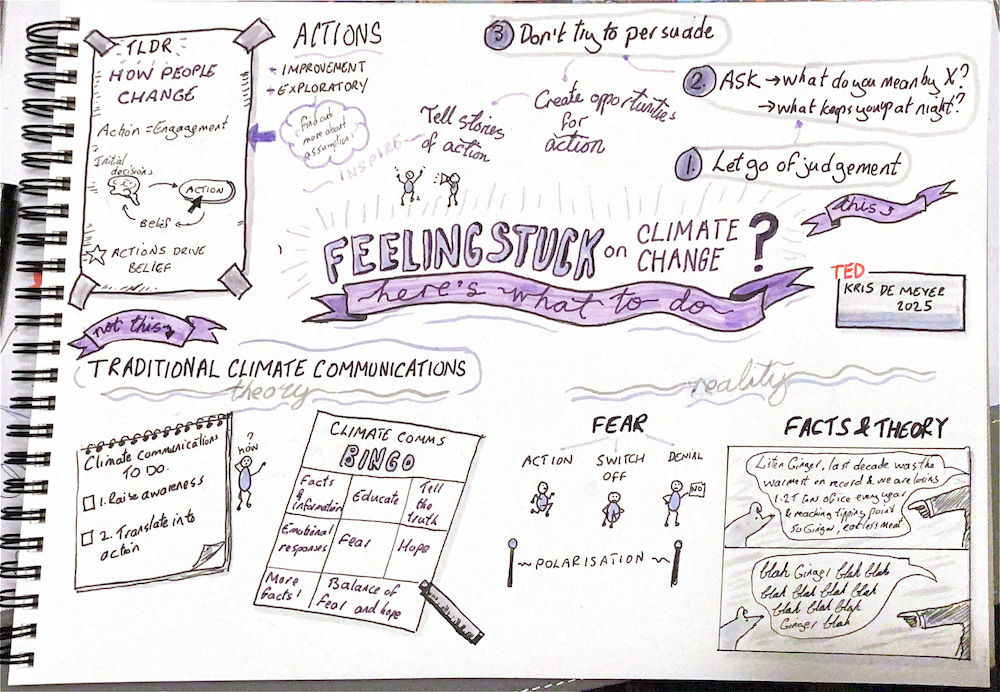
For decades, climate communication has been built on a reasonable but flawed assumption: if people understand the facts, they will act.
This led to strategies focused on:
raising awareness
now more about storytelling to build empathy and relatability
sharing lots of compelling facts
translating science into simpler messages
building fear
building hope
balancing hope and fear
I have definitely indulged in most of the above (not fear – I read Futerra’s ‘sell the sizzle’ in 2012 and never looked back. Yes their approach has progressed since then because… research and evolved thinking…).
As De Meyer points out, facts rarely travel neutrally. Research on identity and climate change demonstrates that when information is perceived as threatening to social identity or group belonging, it is more likely to be resisted or reinterpreted defensively, regardless of its accuracy2. In these contexts, disagreement is less about evidence and more about protecting a sense of “who we are”.
Over time, climate communication unintentionally did three things:
It signalled group membership (“people who care about climate think like this”)
It created an out-group (“scientists”, “activists”, “experts”)
It moralised behaviour, making disagreement feel like a character flaw
Rather than bursting bubbles, this often thickened the boundary between “us” and “them”. The result was not mass persuasion, but stronger identity sorting.
Why arguments bounce off but action sometimes gets through
Whilst filter bubbles may be resistant to arguments, they may be more permeable to behaviour. Observed action functions differently from opinion:
it does not demand agreement
it does not require trust in a distant authority
it is processed as a social signal, not a political claim
Research on social norms shows that misperceptions about what others think and do often act as a barrier to climate action, while making behaviour visible can shift perceptions of what is normal and acceptable without requiring belief change3. This helps explain a pattern many practitioners recognise intuitively: stories about people doing things travel further than stories about what people think. Not because they persuade better — but because they trigger less defence.
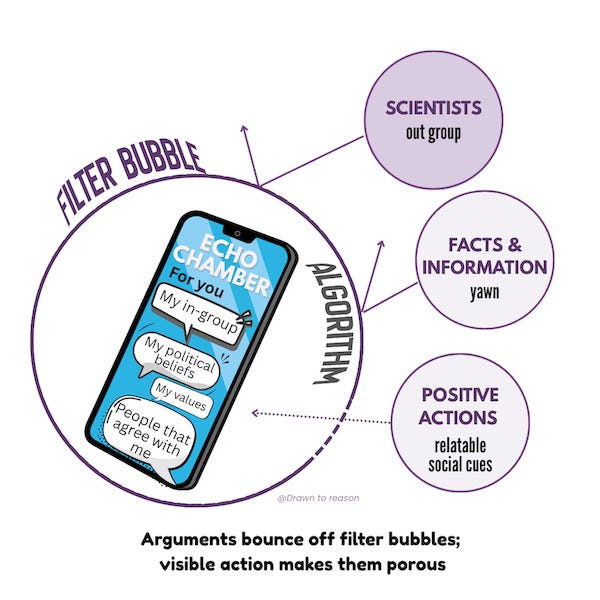
Permeating the bubble without bursting it
If we accept that:
we cannot reliably burst filter bubbles
we cannot argue our way past identity threat
we cannot fix platform incentives from the outside
then the task shifts from conversion to coordination.
Bubbles don’t need to pop, social boundaries don’t need to disappear and long-standing beliefs don’t need to align, they just need to become slightly more permeable.
That permeability is created when actions are visible, ordinary and framed around shared concerns rather than climate identity
I fought hard against the ‘every little helps’ narrative for years and still hate it, (“if everyone does a little, we’ll achieve only a little”, David MacKay, 20084). I used to fight against action-first approaches, like those argued for by Kris De Meyer, believing a compelling argument would work. I now realise that in a polarised age of filter bubbles, misinformation and politicisation of key issues, they are a pragmatic response to structural constraints.
What this looks like in practice
Continuing the storytelling approach that is increasingly popular, bubble penetration requires a subtle shift in the narratives:
1. Focus on the outcomes, not the agenda
e.g. increasing energy reliability rather than taking down fossil fuel corporations or denying people their comforts
2. Identity-aligned messengers
Stories told by tradespeople, small business owners, local leaders, parents will be more relatable. Not “experts” but peers doing cool stuff and achieving outcomes for their communities, businesses etc.
3. Visible, boring competence
Projects that show something worked, someone tried and it wasn’t heroic (well, it was, but more normality than cape-wearing virtue).
You are not persuading across bubbles, you are reshaping what feels possible and normal within them.
Summary
I haven’t found an evidence-based communication strategy that reliably defeats algorithms or dissolves polarisation (and I don’t have the energy to spend hours on TikTok proving it) but there is evidence that arguments harden boundaries whilst everyday action by relatable people softens them.
If climate communication has a future, it may lie less in telling better stories and more in making action quietly visible and ‘normal’, until it no longer looks like “their thing”.
Krause, N. M., Freiling, I., & Scheufele, D. A. (2025). Our changing information ecosystem for science and why it matters for effective science communication. Proceedings of the National Academy of Sciences.
Barnett, J., Pearce, W., & Ahn, J. (2021). Identity, norms and climate change. Current Opinion in Psychology, 42, 101–106.
Sparkman G, Howe L, Walton G. (2021). How social norms are often a barrier to addressing climate change but can be part of the solution. Behavioural Public Policy. 5(4):528-555. doi:10.1017/bpp.2020.42
MacKay, D.J. (2008). Sustainable Energy – Without the Hot Air. UIT Cambridge.