

Why 'Net Zero' became such an easy target

Last week, Kemi Badenoch announced that Conservative candidates are now expected to oppose Net Zero. Reform have hardly been shy about taking aim at it either. Depending on your politics, you’ll either see that as common sense or deeply worrying.
It didn’t surprise me. From a communications perspective, it’s been brewing for a while.
Climate campaigns are no longer primarily trying to convince people that climate change isn’t real. Increasingly, opposition focuses on the policies, technologies and language associated with climate action - a shift from denying the science to delaying or obstructing the response1. We can see that in UK media, this shift is now firmly embedded in political discourse2.
Why Net Zero?
Most people don’t wake up worrying about Net Zero. Between the school run, rising bills, job insecurity, food inflation and the general background hum of existential dread, we’ve all got plenty on our minds already.
‘Net Zero’ isn’t one of them.
Even if your organisation has committed to reaching it, chances are it’s still fairly low down the agenda. It’s a policy label, it’s abstract and it doesn’t tell you anything about the life it’s trying to create. That’s exactly what makes it such an attractive political target.
You can’t easily campaign against warm homes. Calling lower energy bills ‘woke’ is a harder sell. Cleaner air has stubbornly refused to become a culture war. ‘Net Zero’, on the other hand? That sounds like fair game.
Lost in translation
Net Zero is an accountant’s term. It describes a balance sheet, not an outcome that anybody actually experiences. I’ve spent countless hours explaining, drawing, editing videos and otherwise trying to explain it.
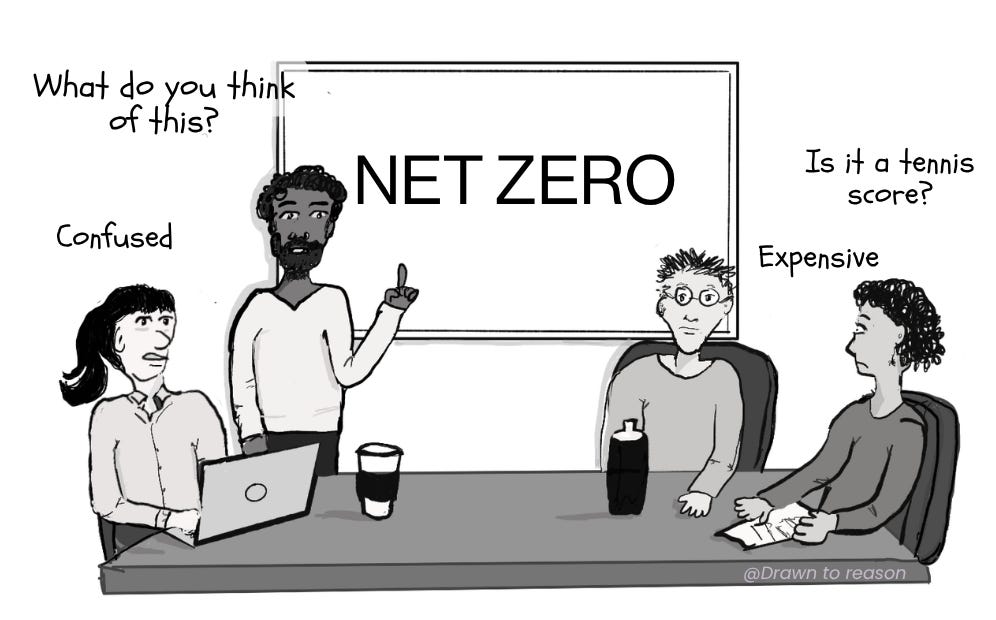
Nobody can picture ‘Net Zero’ in quite the same way they can picture a warm home, money left at the end of the month, a child walking to school breathing cleaner air or not relying on volatile gas prices.
We don’t rally around phrases like:
Fiscal neutrality
Operational resilience
Demand-side management
Resource optimisation
They might sound great in your next quarterly review but they make terrible slogans.
‘Net Zero’ belongs in carbon accounting, strategy documents and engineering reports. It’s a useful metric for measuring emissions entering and leaving the atmosphere. Somewhere along the way, though, we started treating it as though it was something the public should aspire to.
People don’t aspire to accounting terms, they aspire to better lives.
This is what the linguist George Lakoff calls ‘framing’. His favourite example is ‘tax relief’: repeating that phrase, even to argue against it, embeds the idea that tax is an affliction before anyone debates a single policy.
‘Net Zero’ illustrates the same principle. The phrase describes an accounting outcome rather than an everyday experience, leaving a vacuum that others are free to fill with their own meanings. Nobody built a relatable picture to go with it (my team used a complicated bathtub analogy), which is exactly why simply defending the phrase won’t work. As Lakoff put it, negating a frame only reinforces it3.
Meaning well
Net Zero has become a symbolic term onto which people project wider hopes, frustrations and political identities.
Like Brexit, woke or political correctness before it, Net Zero has evolved beyond its technical definition. It has become a symbolic term onto which people project wider hopes, frustrations and political identities.
In one room people hear innovation, job opportunities and energy independence. Whilst in another people hear higher taxes, government overreach and being told what car to drive. The phrase has become increasingly detached from its technical definition and increasingly attached to whatever people already believe.
That’s a communications problem as much as it is a political one.

From science to symbols
This has been happening for several years. Rather than disputing climate science itself, opponents increasingly focus on specific policies such as heat pumps, low traffic neighbourhoods, electric vehicles and Net Zero, portraying them as expensive, elitist or disconnected from everyday life4.
This fits with a much broader body of research showing that people rarely reject scientific evidence because they lack information. Instead, attitudes are shaped by identity, values, trust and political worldviews5. I’ll delve into this further in a future article but, for now, this isn’t primarily a battle over facts. It’s a battle over meaning.
I wrote an article last year asking:

I think we have our answer now.
Not because the goal itself is flawed, but because we’ve allowed the conversation to become anchored to a phrase that was never designed to carry so much political and emotional baggage.
Net gains
So what should our slogan be?
Beat the bills?
Behavioural science and climate communication research consistently show that messages are more persuasive when they connect with people’s existing values and lived experience rather than abstract policy goals6.
Freeze bills, not pensioners?
Equally, repeated crisis messaging can increase disengagement, while simply providing more facts rarely changes deeply held views when those facts conflict with identity or worldview7.
Keep Britain cosy?
We don’t need to abandon Net Zero as a policy goal, but somewhere along the way we forgot to tell people what Net Zero was actually for. We talked about carbon budgets instead of comfortable homes. Emissions trajectories instead of secure jobs. Targets instead of tangible improvements to people’s lives.
Keep our kettles on? / Keep Britain brewing?
Climate action has never been about achieving Net Zero. Net Zero is simply the accounting method we use to know whether we’re making progress.
Take back power?
The destination has always been a healthier, fairer, more resilient society.
Own our power?
Perhaps it’s time we started talking about that again.
Power without Putin?
Stop communicating climate policy. Start communicating the future people actually want.
If you found this interesting, allow me to direct your scroll to another piece I found before I hit ‘publish’ in a similar vein.

Lamb, W. F., Mattioli, G., Levi, S., Roberts, J. T., Capstick, S., Creutzig, F., ... & Steinberger, J. K. (2020). Discourses of climate delay. Global Sustainability, 3.
Hayes, S., Gabbatiss, J., & Butler, C. (2025). From climate scepticism to discourses of delay in UK editorials. Public Understanding of Science, 34(7), 832–851.
Lakoff, G. (2004). Don’t Think of an Elephant! Know Your Values and Frame the Debate. Chelsea Green.
Fortin, M.-F., Olivier, A., Vincent, S.-J., Laflamme, N., Soland, R., & Gajevic Sayegh, A. (2025). A typology of climate obstruction discourses: Phenomenon, action, source. Climate, 13(9), 190.
Rekker, R. (2021). The nature and origins of political polarization over science. Public Understanding of Science, 30(4), 352–368.
Heath, C., & Heath, D. (2007). Made to Stick: Why Some Ideas Survive and Others Die. Random House.
Većkalov, B., Geiger, S. J., Bartoš, F., White, M. P., Rutjens, B. T., van Harreveld, F., ... & van der Linden, S. (2024). A 27-country test of communicating the scientific consensus on climate change. Nature Human Behaviour, 8(10), 1892–1905.
So helpful, Sandra, thank you!!