


It’s very easy to get caught up in the downsides of neurodiversity; we live in a world not built for our brains and can get overwhelmed trying to fit in but, in an indulgent moment masquerading as research, I spoke to some colleagues I have known for many years about the upsides of dealing with an ADHDer (including me – card carrying combined-type) and their observations were interesting and inspired this month’s cartoons.
The upsides of this particular neurotype are often listed as creativity, empathy, hyperfocus etc. and they can be true but I want to focus more on what a different way of processing the world can bring to an organisation, a team, a problem.
This isn’t about “superpowers”
I’m generalising here – all brains work differently and I’m not replaying the old superpower tropes. I’m summarising my lived experience backed up by academic research, with the intention of widening the conversation about the benefits of a decent Equality, Diversity and Inclusion recruitment policy genuinely considering neurodiversity too.
The long and short is that cognitive traits are not strengths or weaknesses in isolation — they are context dependent.
What teams actually benefit from
1. Pattern recognition and reframing
“Ooh look a butterfly”
I have a wonderful friend, Emma, who’s brain works much like mine and we have the most inspiring, energetic conversations. I suggested we do a podcast and Emma (more intuitive and self-aware than me) laughed, “No we shouldn’t! We go off on so many tangents, interrupt each other and sometimes never finish stories, or come back to them 30 minutes later. How would anyone follow it?!”
She’s right – to a neurotypical observer, our conversations would seem impossible. Many people with ADHD process information in a highly associative way, rather than following a linear path, ideas are connected across domains.
This can look like distraction (“ooh look a butterfly”), but in complex or shifting systems it often looks like insight. ADHD has been linked with divergent thinking1 and idea generation2 so, in a workplace, this may not be helpful for chairing meetings to a tight agenda but workshopping ideas or developing processes are our forte.
In my workplace I am known as a connector – of people, projects and ideas as I often make connections quickly across projects and people — sometimes messily, but often in ways that accelerate collaboration; and yes, I may interrupt when I find one because if I don’t my brain will have moved on and it will be lost (I’m getting better at just making a note – the chat and mute functions are my saviours!).
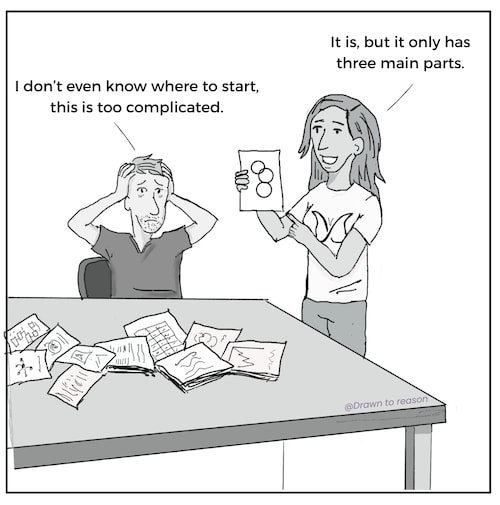
2. Tolerance for complexity and ambiguity
Living with ADHD means constantly navigating environments not designed for you. I tried to imagine a true ADHD-friendly workplace and struggled (perhaps a future post that definitely needs brainstorming with likeminded types).
While structure is essential for many of us, the ‘unconventional mind’ types are often comfortable iterating in messy, evolving problem spaces once engaged so when projects are ambiguous, fast-moving or poorly structured, that adaptability is an advantage3.
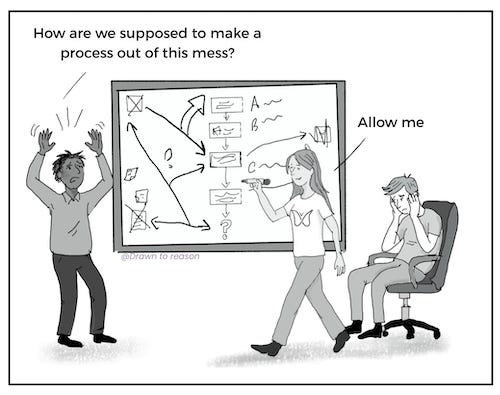
3. Social attunement and moral radar
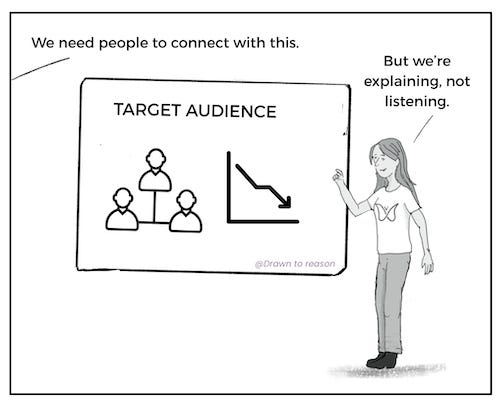
ADHD is frequently associated with emotional intensity and sensitivity4. While that can be exhausting in unsupportive environments, it can also translate into acute awareness of group dynamics and fairness.
In meetings, this may show up as someone noticing who is not being heard, or when a message lands badly. Emotional intensity can heighten sensitivity to interpersonal dynamics — which, in communication or brand work, can surface blind spots early.
4. Energy under pressure
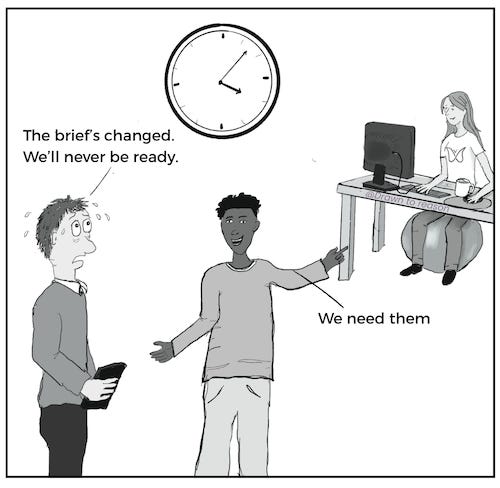
I know I’m not alone in needing a tight deadline to pull out my best work. I am not physically capable of starting something that’s not due for weeks so I often have to set false deadlines and accountability with colleagues (I also consider ‘future me’ a colleague that I sometimes need to be kind to and not dump a load of stuff on).
Whilst some colleagues can be frustrated by a perceived lack of progress, who do they come to when tomorrow’s speaker cancels at 4pm and they need someone to develop and deliver at 9am (true story – they bought me lunch at least).
This isn’t sustainable as a default mode, but in acute moments, it can be an asset.
How can workplaces adapt for different neurotypes?
When organisations design roles around one narrow definition of productivity and communication, they misclassify difference as deficit. When they design for variation, they unlock capacity.
This could be a whole piece but for now I’ll give a few examples that work for me. The main thing is to let people play to their strengths and make adjustments for their challenges.
Maybe they think better whilst moving – so let them have walk/think breaks and space;
Many of us focus better whilst fidgeting or doodling – so let them have the fidget toys and don’t roll your eyes at the masterpiece on the notepad;
Agree deadlines, prioritisation and accountability early on – structure is important;
Keep communications clear, concise with an obvious call to action (doesn’t everyone want that?);
If you’re waiting for a response, feel free to politely chase – they may well have forgotten, thought they replied, accidentally deleted it and couldn’t remember who sent it…
Practical implications for leaders
I hope I’ve inspired you to consider the benefits of a diverse workforce (there are many more) so my final, more general advice, would be to:
Value outputs, not process conformity
If presenteeism and conformity are rewarded over contribution, expect innovation to stall.
Make space for divergent thinking before convergence
If ‘because we’ve always done it this way’ is your stock answer, you’ll probably be left behind.
Invite perspective shifts explicitly
Be open to solutions coming from directions, even planes you weren’t aware of.
Notice who reframes problems
Just because you didn’t see it, doesn’t mean it’s not there. They’re not being negative, they’re horizon scanning and saving you wasted resources.
Conclusion
Current data suggest just under 7% of the population have ADHD as it is currently recognised5. However, with the growing realisation that it doesn’t just affect young, white boys, diagnoses are increasing as an overdue adjustment takes place.
That means the chances of you having an ADHD colleague is slightly lower than having a left-handed one (possibly the same person as there is a connection6) (10%) but far greater than a having a vegan colleague (4.5% UK population7) or one with red hair (1-2% global population but over 10% in Scotland & Ireland8).
So the question is not whether you have ADHD colleagues, the question is whether your systems allow their contributions to make your workplace and outputs awesome.
White, Holly A., Shah, Priti.(2006). Uninhibited imaginations: Creativity in adults with Attention-Deficit/Hyperactivity Disorder. Personality and Individual Differences. Volume 40, Issue 6, Pages 1121-1131.
Hoogman M, van Rooij D, Klein M, Boedhoe P, Ilioska I, et al. (2022). Consortium neuroscience of attention deficit/hyperactivity disorder and autism spectrum disorder: The ENIGMA adventure. Hum Brain Mapp. 43(1):37-55.
Nordby ES, Guribye F, Nordgreen T, et al. (2023). Silver linings of ADHD: a thematic analysis of adults’ positive experiences with living with ADHD. BMJ Open 2023;13.
Sedgwick JA, Merwood A, Asherson P. (2009) The positive aspects of attention deficit hyperactivity disorder: a qualitative investigation of successful adults with ADHD. Atten Defic Hyperact Disord. 11(3):241-253.
Song P, Zha M, Yang Q, Zhang Y, Li X, Rudan I. (2021). Global Health Epidemiology Reference Group (GHERG). The prevalence of adult attention-deficit hyperactivity disorder: A global systematic review and meta-analysis. J Glob Health. 2021 Feb 11;11:04009.
Nastou E, Ocklenburg S, Hoogman M, Papadatou-Pastou M. (2022). Handedness in ADHD: Meta-Analyses. Neuropsychol Rev, 32, 877-892.
https://vegsoc.org/facts-and-figures/
https://medicover-genetics.com/red-hair-its-in-your-genes/
Hi Sandra Really enjoyed reading your piece. Found it very interesting and thought provoking especially as I've recently found out I'm autistic and have been doing reading into understanding neurodiversity. Learning the complexity of the neurodiversity that exists. That some people can be both autistic and be ADHD for example and have one part of their brain almost competing with another part. It has also got me thinking like you about how we don't consider neurodiversity in developing JDs or creating a team of people. Staff are expected to work to their job role not necessarily to their strengths. Especially in local government we can be very rigid about job roles, sometimes driven by a desire to be fair and equal. Though this is probably coming from a place of neurological thinking. Like you I'd be interested to understand what a workplace that seeks to make the most of neurodiversity would look like and how such a workplace might be created and encouraged. You've got my brain spinning in all directions trying to figure this out. Maybe a workplace based on tasks rather than roles might be part of the answer along with a more dynamic approach to assigning responsibilities or even allowing people to choose what the do and how they contribute. That would definitely blow the minds of neurological managers lol!!! Look forward to your future blogs and drawings 👍