


January is the annual performance review none of us asked for. Entire industries profit off the idea that we will finally become small enough, neat enough, optimised enough to be worthy (of what?).
The season of self-correction: Veganuary, decluttering and gym memberships that expire faster than a kale smoothie.
It is also the season of “less”: eat less, scroll less, emit less - less visible even (as a middle-aged woman, I’ve got physical and online invisibility nailed – even the algorithm supports this).
The ‘new year, new you’ trope mirrors the old sustainability narrative perfectly: you are the problem - minimise accordingly.
Note: if you already move through the world assuming your voice belongs in every room, you are welcome here, but you may not be the target audience.
This piece is for everyone else, the ones who were raised on a cultural diet of ‘be less’, ‘speak softer’, ‘don’t be difficult’ and ‘be grateful to have a seat at the table’.
I’d like to offer a different start to 2026
Instead of trying to be less — less indulgent, less flawed, less carbon — what if the real work is to be more?
More influential, more aligned with your strengths and more capable of shaping the systems you already touch.
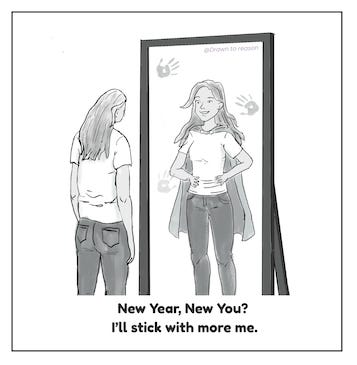
Not New Year, New You
New Year, MORE You
We all have a handprint – what if we lean harder into it?
1. Taking the gloves off
If your carbon footprint is about what you consume, your handprint is about what you cause. From the decisions you shape, the people you support, the procurement you shift, the norms you change, the conversations you reframe, the policies you unblock and the little sparks of influence that ripple outward.
People are far more likely to act when the action feels like an extension of who they already are and they believe their influence matters1. Not a diet, not a punishment, not a ritual of self-denial – i.e. not when asked to make personal sacrifices with little connection to systems or influence2.
Your handprint is not self-improvement - it is self-expansion.
2. This January, map your strengths — not your deficiencies
Climate action is so much more than simply what we buy or consume, it extends across the many roles and contexts we all occupy, as members of communities, participants in organisations and as citizens who can influence policies3.
So map your influence:
The Influence Map
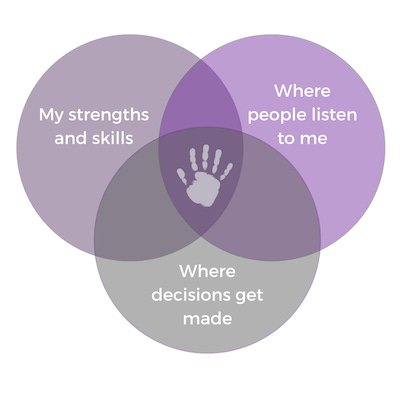
Where do you have the strongest potential handprint?
What skills do I naturally use to help others or solve problems?
Where do people listen to me?
Which teams, communities, systems or decisions do I touch?
Where did I unintentionally influence something last year?
Where is there room to step in a little more boldly?
3. Use your influence
Meaningful actions create agency spirals — one action fuels the next, so choose one area where you already have influence and go deeper.
If colleagues trust your judgement, nudge procurement in a better direction.
If you handle budgets, treat whole-life costs as standard practice.
If you teach, embed future-thinking into your curriculum.
If you’re a manager, normalise sustainable defaults.
Outside of work too – can you implement a plastic-tat free policy in your kids’ school pta? Introduce a second-hand kit rail at the local sports clubs (I’m still working on this – competition leotards should be banned), or bike racks at the football club (seriously, don’t get me started on this rant).
Small expansions in an existing locus of influence produce disproportionately large ripple effects as individuals embedded in organisational networks have far greater leverage than they realise. As we sprint towards climate tipping points, remember that they can be positive too so be part of the good ones4.
4. Be more you in 2026
People act more on climate when they experience self-expansion, not self-erasure. The shift isn’t “be better”, it’s be impactful.
Does 2026 need a thinner, cleaner, tidier version of you? Or does it needs more you? A you who takes your own influence seriously, a you who recognises that climate action is not a personal purity ritual but a relational, political and cultural one and can help promote agency and belief in others5.
If you’re going to be less anything this year, let it be these:
Be less conflicted – pick your passion and dig in
Be less quiet – amplify the science, the wrongs and the solutions, that said:
Be less argumentative – stay out of science denial debates and join with the problem solvers instead. Your mental health will thank you!
New Year, more you.
Be more awesome in 2026.
Hamann, K. R. S., Wullenkord, M. C., Reese, G., & van Zomeren, M. (2025).
Believing that we can change our world for the better: A Triple-A (Agent–Action–Aim) framework of self-efficacy beliefs in the context of collective social and ecological aims. Personality and Social Psychology Review.
Karine Lacroix, Jennifer P. Carman, Matthew H. Goldberg, Abel Gustafson, Seth A. Rosenthal, Anthony Leiserowitz, (2022). Does personal climate change mitigation behavior influence collective behavior? Experimental evidence of no spillover in the United States. Energy Research & Social Science, Volume 94,
Lorraine Whitmarsh, Wouter Poortinga, Stuart Capstick, (2021). Behaviour change to address climate change. Current Opinion in Psychology. Volume 42, December 2021, Pages 76-81
Ilona M. Otto, Jonathan F. Donges, Roger Cremades and Hans Joachim Schellnhuber (2020). Social tipping dynamics for stabilizing Earth’s climate by 2050. Sustainability Science. 117 (5) 2354-2365
Cutler, J., Contreras-Huerta, L.S., Todorova, B. et al. (2025). Psychological interventions that decrease psychological distance or challenge system justification increase motivation to exert effort to mitigate climate change. Communication Psychology 3, 148.
More influential, more aligned with your strengths and more capable of shaping the systems you already touch.
I love this message!