


TL:DR
Most people do care. They’ve just stopped saying it out loud and the algorithm reinforces that. Your job isn’t to convince the sceptics — it’s to make the caring majority visible again.
Remember when most UK Councils were declaring climate emergencies and committing to building green housing and mitigating flood and heat risk? That wasn’t ancient history, it was 20211.
So how, in 2025, has the tone has flipped so dramatically? Suddenly net zero is woke, Councils are cutting funding for energy (and cost) saving initiatives and climate deniers are crawling out from under all sorts of rocks.
My LinkedIn feed is full of weary practitioners who’ve spent a career building momentum and now feel like the world’s turned hostile. It hasn’t. What’s shifted is the social norm signal — the subtle cues that tell us what’s normal, expected and approved.
Social norms
I first studied social norms during my PhD when I was trying to understand human behaviour. Social norms are the shared, often unspoken rules that guide what behaviours are acceptable in a given context.
They typically fall into two categories:
• Descriptive norms = what people do (or what we perceive they do).
• Injunctive norms = what people approve of / expect (what’s socially acceptable).
Online platforms inflate the first and can fictionalise second.
Norms are powerful, as social creatures, we look to others to guide our action. However, the bias arises when we misperceive norms (especially descriptive ones) — thinking something is common when it isn’t — which can lead to bad group behaviour (e.g. littering because we think “everybody does it”). Of course social norms vary across cultures and contexts: what’s normal in one setting may be taboo in another.
Media, particularly online, presents each of us a different version of reality. This algorithmic curation exaggerates extreme expressions, shifting the perceived midpoint of acceptable opinion. Over time, moderation looks timid, consensus looks dull and outrage looks authentic. This effect is described as an “external-visibility bias” — the more engagement a post earns, the more “real” it feels, regardless of how representative it actually is2 3.
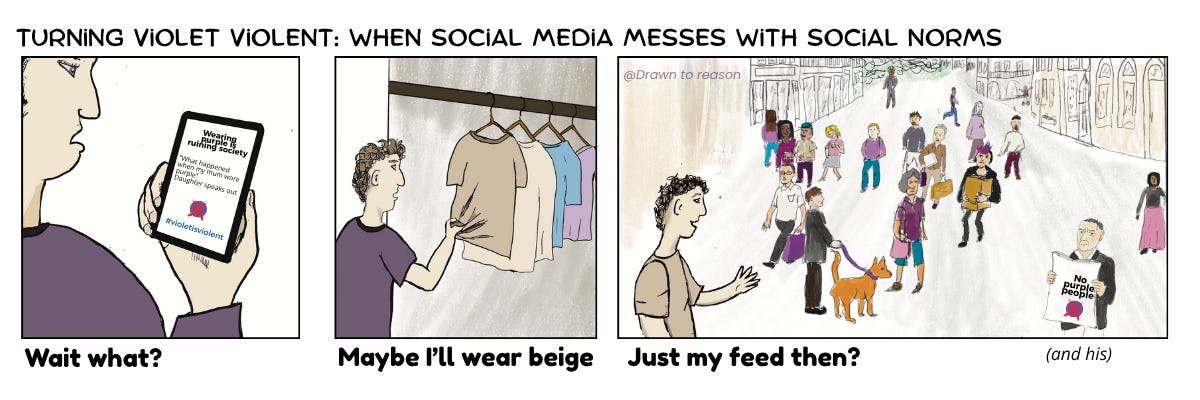
Algorithmic curation exaggerates extreme expressions, shifting the perceived midpoint of acceptable opinion. Over time, moderation looks timid, consensus looks dull, and outrage looks authentic. For climate, this feels fatal. The more visible something is, the more legitimate it feels and when the apparent norm turns cynical, genuine majorities self-silence — the classic spiral of silence.
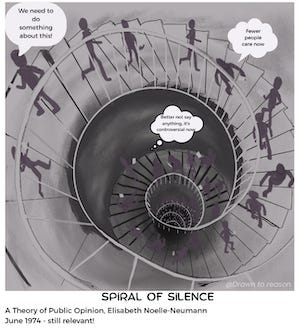
Climate action rides on identities and norms. Emotions like hope and pride sustain effort and small, repeated norm cues can move behaviour at scale. In recent eventful years, the science holds but the signal is drowned out by feeds that over-amplify conflict and under-represent consensus. The majority didn’t vanish, its visibility did.
What the algorithm doesn’t show (& policymakers are apparently unaware of)
Myth 1: People stopped caring about climate
No they didn’t but it is being overshadowed.
77–80% of the British public remain concerned about climate change45 and support stronger government action6. However, only 53% now rank it among the most important issues facing the country, a drop from 69% in 2023.
Interestingly, women, younger adults, older adults, and degree-holders report higher concern levels. People living in less deprived regions are more engaged, reinforcing concerns that climate action remains stratified along socio-economic lines7.
Myth 2: immigration and “wokeness” are what everyone’s talking about
They’re what the media is talking about and that sets the agenda8. As of June 2025 the most common issues reported as concerns (in the UK) were
Immigration at 51 %
Economy at 48 %
Health/NHS at ~32 %
Housing ~18 %
Environment ~18 %9
It’s a media salience trick: whatever dominates the front pages feels like the nation’s obsession. But environment is still in the top 5, despite being minimised by mainstream media.
Myth 3: anti-climate voices are the new mainstream
That’s what the (fossil-fuel funded) platforms want you to think.
Social algorithms rank content that sparks engagement — anger, fear, disgust — far above calm agreement. A range of studies show that outrage-fuelled posts spread significantly faster and farther than neutral or consensus-based content1011.
The result? A distorted mirror. Each of us sees more of what we react to, until our feed becomes an echo chamber of our worst suspicions. We assume everyone else sees the same thing, so the angry few look like the majority. This is pluralistic ignorance12 — when we believe that our private views are different from those of the majority so we stay quiet and adjust our behaviors to conform to what we perceive as the societal norm.
Where this leaves us
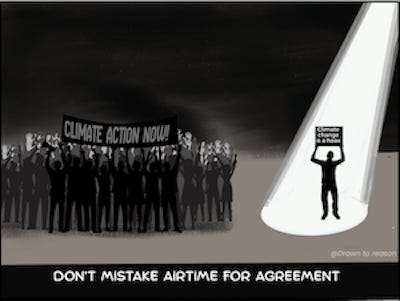
Perceived norms drive policy. When politicians or business leaders think public support for climate action has collapsed, they hesitate. The truth: the majority haven’t changed their minds — they’ve lost confidence that others share them. The loud minority simply hogged the spotlight.
Making climate action mainstream again
Lead with the real majority
Every time you talk about climate, remind people most folk support action. Facts don’t shift values, but they do correct misperceptions of norms.
Support the work of the the89percent project to turn press coverage around.
Click wisely
Algorithms learn from you so don’t reward outrage with your attention. Share content that reflects the world you want to normalise — community projects, businesses doing good, billionnaires paying their taxes (!).Show the normal, not the novel
Outrage gets airtime so normality needs visibility. Highlight everyday climate work such as retrofits, river clean-ups, bus-lane wins. Make caring visible.Name the distortion
Tell audiences their feed is biased toward conflict as awareness breaks the spell. Once people know they’re seeing a false reality, they stop mistaking it for the world.Keep showing up
The spiral of silence only breaks when people who care speak — calmly, consistently and publicly. That’s how new norms form.
How to make caring visible again
Show the real majority.
Keep saying what’s normal, not what’s noisy. “Most people want clean energy” is still true, as is ‘most people are concerned about the climate crisis’.Keep it visible.
Share progress regularly — a photo, a story, a headline — so action feels like the default, not the exception and boost others’ content so you' don’t look like a lone wolf.Use human voices.
People believe people, not posters. Let peers, neighbours or colleagues tell the story.Feed the algorithm something better.
Don’t click on outrage, share constructive posts instead. The internet shows more of what we feed it (this will also help your mental health!).End on pride, not guilt.
“Look what we fixed together” rather than “look what’s broken.”
We all need less negativity on our feeds right?
Howarth & Fankhauser (2021). We’ve declared a climate emergency, now what? LSE. Available here.
De Ridder, J., Van Noort, G., & Veling, H. (2024). Inside the funhouse mirror factory: How social media inflates extreme expressions and shifts perceived norms online. Current Opinion in Psychology, 55, 101752.
Fiesler, C., & Proferes, N. (2024). External visibility and social norm effects on self-disclosure in online spaces. Information, Communication & Society, 27(3), 456–472.
Department for Energy Security and Net Zero (DESNZ), 2025. Public Attitudes Tracker: Spring 2025 – Renewable Energy and Net Zero Findings. https://www.gov.uk/government/statistics/desnz-public-attitudes-tracker-spring-2025
Mccombs, Maxwell & Shaw, Donald. (2017). The Agenda-Setting function of mass media. The Agenda Setting Journal. 1. 10.1075/asj.1.2.02mcc.
S. Rathje, J.J. Van Bavel, & S. van der Linden, (2021). Out-group animosity drives engagement on social media, Proc. Natl. Acad. Sci. U.S.A. 118 (26)
Brady W. et al., (2021). How social learning amplifies moral outrage expression in online social networks.Sci. Adv.7,eabe5641.
https://thedecisionlab.com/biases/pluralistic-ignorance
Reuters Institute for the Study of Journalism (2025). Digital News Report 2025 – UK section. University of Oxford.
Ofcom (2025). News Consumption in the UK 2025.
Masur, P. K., et al. (2023). “External-visibility bias and self-silencing online.” Social Media + Society.
Fiesler, C., & Proferes, N. (2024). “External visibility and norm distortion on social platforms.” Information, Communication & Society.
HMRC & Behavioural Insights Team (2012). Applying behavioural insights to reduce fraud, error and debt. UK Cabinet Office.
Behavioural Insights Team (2013). Applying behavioural insights to organ donation: Preliminary results from a randomised controlled trial. UK Cabinet Office.
Goldstein, N. J., Cialdini, R. B., & Griskevicius, V. (2008). “A room with a viewpoint: Using social norms to motivate environmental conservation in hotels.” Journal of Consumer Research, 35(3), 472–482.
Allcott, H., & Rogers, T. (2014). “The Short-Run and Long-Run Effects of Behavioral Interventions: Experimental Evidence from Energy Conservation.” American Economic Review, 104(10), 3003–3037.
Andor, M., et al. (2018). “Social Norms and Energy Conservation Beyond the US.” Energy Economics.
Lütkenhaus, R. O., McLarnon, M., & Walker, H. (2023). “Norms-Shifting on Social Media: A Review of Strategies to Shift Health-Related Norms among Adolescents.” Review of Communication Research, 11, 127–149.
van der Laan, L., et al. (2024). “Norms-Shifting on Social Media.” University of Twente Review.
Fan, R., et al. (2016). “Anger Is More Influential Than Joy: Sentiment Correlation in Weibo.”arXiv:1608.03656.
American Psychological Association (2023). How and Why Misinformation Spreads.