


Content note: This post includes a cartoon that uses a deliberately provocative analogy (mention of sexual violence) to highlight media bias and the false balance given to climate denial. Please read with care.
In 2009, the United States came close to passing landmark legislation to limit emissions. The Waxman–Markey cap-and-trade bill had support. It was viable. But fossil fuel firms, afraid of profit losses, poured millions into lobbying and hired economic consultants to produce reports showing massive costs (and conveniently ignoring any benefits).
These reports weren’t just circulated in policy circles. They made their way into media headlines, political speeches and even school debates.
The bill failed. It is estimated that this delay alone imposed $60 billion in social costs from emissions, health impacts, and economic instability that could have been avoided1.
For years, politicians, particularly those across the pond have been proclaiming:
"It's a hoax."
"It’s just a money-making industry."
"They’re getting rich by telling you carbon is the enemy."
"A lot of it's a hoax. I mean, it's a money-making industry, okay? It's a hoax, a lot of it.”
Trump regarding climate change, at a rally in Hilton Head, S.C. on December 30, 20152.
The sentiment is still being parroted today globally so my question is why?
This newsletter is as close to a conspiracy theory as I will get but I want to explore two things:
The actual benefits of climate action to our daily lives that are well researched but severely under-reported
Why the media and policymakers continue to ignore the costs to human health, the economy and nature
I guess there’s a third thing – what we can do about it.
What if it's a big hoax and we create a better world for nothing?
Ask a random member of the public what they associate with “climate action”, and you’re likely to hear: expense, sacrifice, compromise. That’s because the benefits (though widely documented in peer-reviewed literature) remain under-reported and under-communicated.
Joel Pett’s incredible and widely used cartoon3 (which I’ve just found out you can get on a t shirt!) asked (in 2009) ‘What if it's a big hoax and we create a better world for nothing?’. 16 years later and it’s still as relevant as ever.
So let’s look at the better world we could create if the tangerine toddler and lobbying leeches don’t get their way:
Globally, studies have shown that decarbonisation policies can lead to:
• Dramatic reductions in premature deaths from air pollution4
• Improved diets and reduced rates of heart disease and diabetes5 6
• Reduced hospitalisations and vulnerability during extreme heat or drought7 8
• Urban improvements like safer streets, lower noise and more active transport9
Wait - if climate policies are so positive, why don’t these make headlines? Why is policy debate dominated by cost estimates and scare stories?
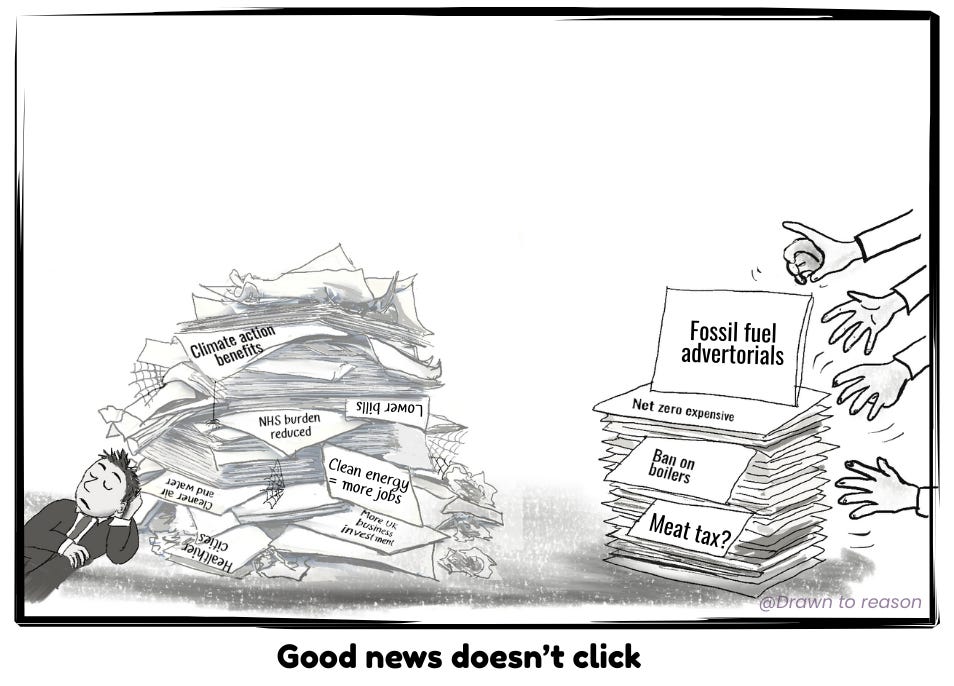
There are two main reasons for this:
Bad news bias and the media's commercial model
Media outlets don’t need oil money to skew the narrative—our brains do it for them10. Negativity sells, fear lingers,1112 and good news about better diets and cleaner air rarely gets clicks. So we get scare stories about heat pumps, not the real costs of dirty air13. That’s why newsrooms, chasing attention in a saturated digital market, lean heavily on headlines that evoke fear, outrage or conflict.
Why focus on the negative side of climate action?
We hear all about the supposed costs of green policies: how heat pumps are expensive, how low-emission zones might fine drivers, how Net Zero will “kill the economy”; yet we hear far less about the very real costs of inaction: rising deaths from air pollution, hospitalisation spikes during heatwaves, energy bill shocks linked to fossil fuel dependency.
Who pays for the bad news?
That selective storytelling isn’t an accident. It’s a product of strategic fossil fuel lobbying, economic framing and media dependence on corporate advertisers.
Since at least the 1990s, fossil fuel companies have poured money into PR firms and economic consultancies to produce models inflating the costs of climate policy—and suppressing co-benefits like cleaner air, energy security, or health improvements14.
These findings were then funnelled to journalists, policymakers and pundits, shaping the entire public debate. Reports from fossil-funded think tanks like the Heritage Foundation or American Enterprise Institute were covered far more widely than peer-reviewed papers from scientists and economists.
Meanwhile, fossil companies paid for native advertising in top outlets (as op-eds and sponsored content)15 and social media ads that look like search results16 that kept their framing front and centre.
Media organisations, dependent on ad revenue and political access, rarely interrogated these claims. Instead, they leaned into “fairness” narratives that gave fossil-funded opinions equal footing to scientific consensus.
This is what you’re doing when you platform climate deniers, fossil lobbyists and alt-right-types in climate discussions:
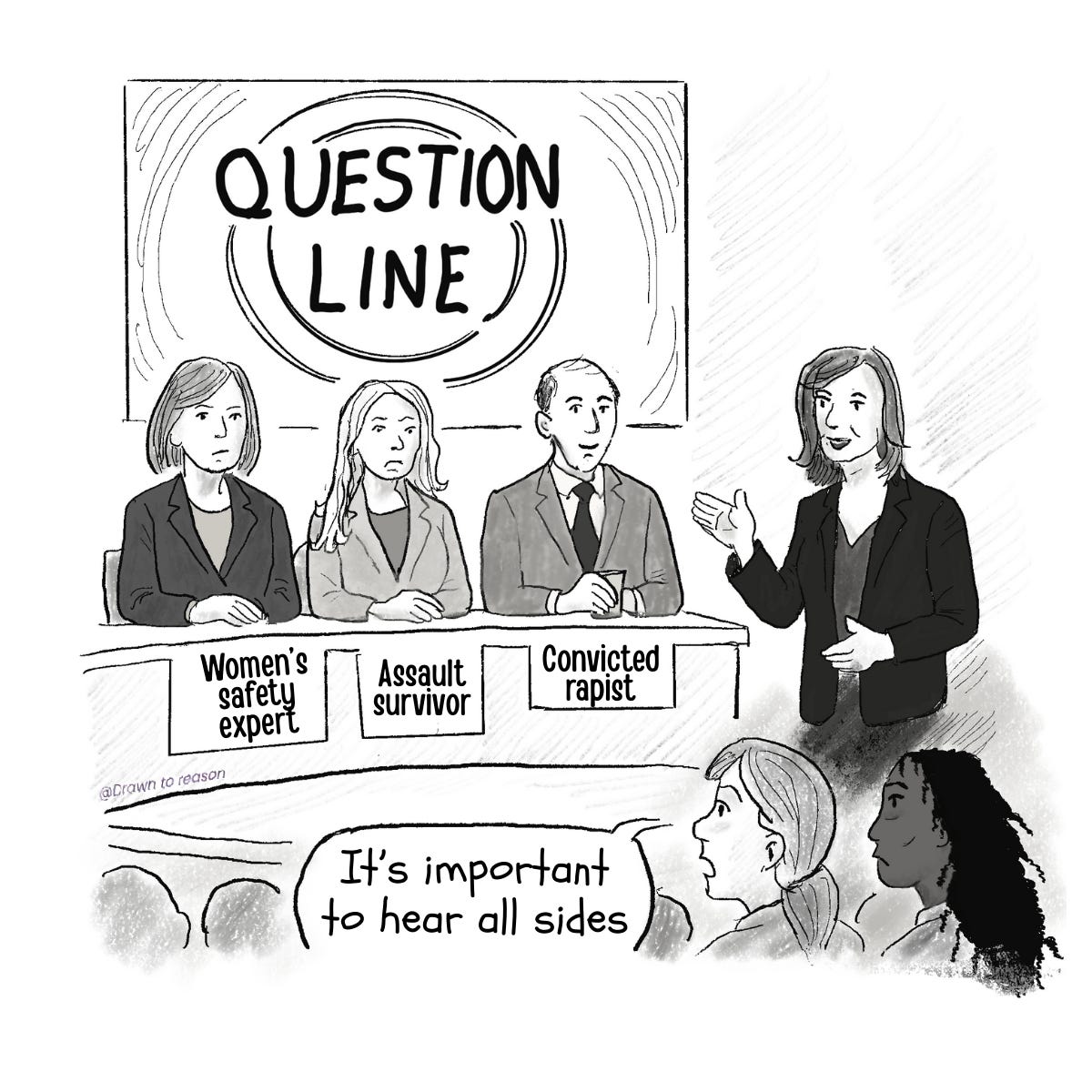
Even algorithmic ‘neutrality’ tilts toward controversy — boosting clickbait and burying consensus. This creates a distorted public sphere where the costs of action are exaggerated and the costs of inaction are hidden (see this post for more on that).
The result? A media and policy environment that acts as if the only real cost is doing something — not doing nothing.
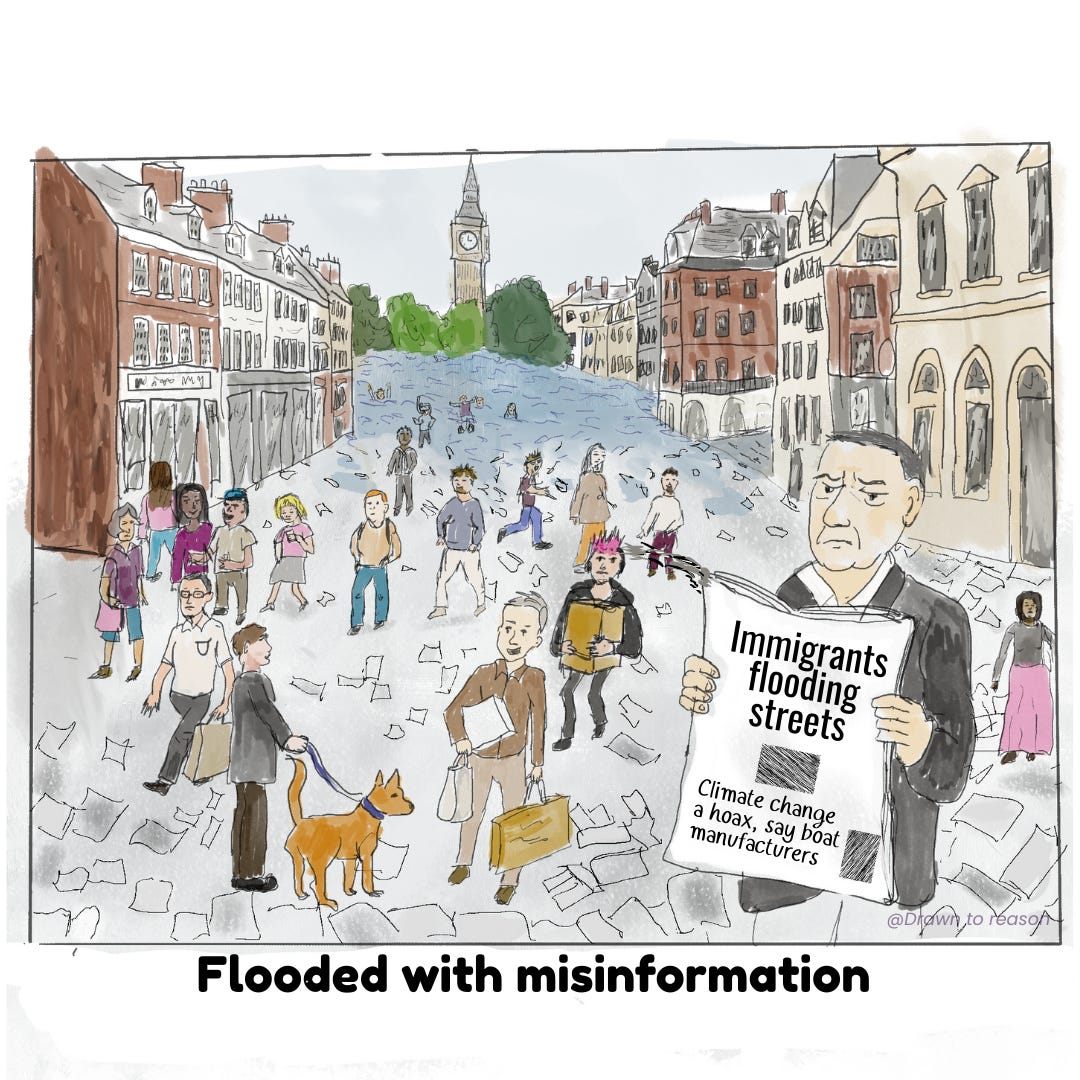
We panic about small boats, but barely blink at flooded cities. The media lens zooms in on immigration “costs” while quietly cropping out the economic and human toll of climate breakdown. It’s not just a distortion—it’s distraction by design.
So let’s correct the focus.
Globally, fossil fuel companies received $7 trillion in subsidies last year. That’s not a typo. For every £1 we invest in clean energy, we shovel nearly four into prolonging the problem...
The ROI (return on inaction)
In the UK alone, fossil fuel subsidies and tax reliefs remain substantial. According to the International Institute for Sustainable Development, the UK government provided around £17.3 billion in support to fossil fuel producers and consumers in 2021–22—despite net zero commitments. Globally, subsidies to fossil fuels reach as high as $7 trillion annually when accounting for health and environmental costs (IMF, 2023).
Compare that to what fossil fuel companies spend to protect these subsidies: in the US, industry groups spent roughly $354 million on lobbying and campaign finance in 2015–16 and received $29.4 billion in return. That’s a return on investment of over 8,000%.
8,000%!
This isn’t just money down the drain, it’s thousands of avoidable hospital visits and funerals. Air pollution—largely caused by fossil combustion — accounts for nearly 1 in 5 deaths worldwide and costs the UK economy an estimated £20 billion annually in health-related impacts.
Objects in headlines may appear larger than they are
Public discourse often pulsates with alarm over the costs of immigration, yet the actual fiscal impact is modest. According to the Migration Observatory at Oxford (2024), immigration costs represent less than 1 % of UK GDP, with recent migrants typically contributing more than they consume. Even the increasing costs of running the asylum system (£5.4 billion in 2023/24) remain a small drop compared to the economic and health fallout from climate inaction.
Climate change is projected to cost the UK up to 3.3 % of GDP by 2050 (that’s £74.9 billion for 2024) and as much as 7.4 % by 2100 without mitigation efforts17. Excess deaths from UK heatwaves alone reached nearly 3,000 in the summer of 202218.
Put bluntly:
Immigration brings in nearly £1,000 per household, while climate inaction and fossil fuel handouts drain more than £3,000. Yet only one of those dominates our headlines — and it’s not the one bankrupting us.
Why are we still investing in harm?
This isn’t about austerity or sacrifice. It’s about shifting our resources towards things that actually serve us. Cleaner air. Lower bills. Healthier food. Stronger communities. The research is clear. The benefits are measurable.
Next time someone tells you we “can’t afford” climate action, or stokes fear about heat pumps or low-traffic neighbourhoods — ask instead: why are we spending public money to make things worse?
Ask your councillor, your MP, your party leader — what are you doing to invest in what makes life better, not just more profitable for a few?
And if you're tired of hearing scare stories about the ‘costs of immigration’ while we ignore multibillion-pound handouts to polluters? You're not alone.
It’s time to get our perspective back.
Meng, K.C., Rode, A. (2019). The social cost of lobbying over climate policy. Nat. Clim. Chang. 9, 472–476.
https://www.politifact.com/factchecks/2016/jun/03/hillary-clinton/yes-donald-trump-did-call-climate-change-chinese-h/
https://climateactionreserve.org/blog/2012/08/31/environmental-cartoons-by-joel-pett/
Watts, N. et al. (2024). The 2024 report of the Lancet Countdown on health and climate change. The Lancet Planetary Health, 8(1).
Roca-Barceló, A. et al. (2024) Health co-benefits of climate mitigation strategies: a modelling study of 17 countries.
Environmental Epidemiology, 8(2), e288.
Milner, J. et al. (2017) Projected health effects of realistic dietary changes to address climate change in India.
The Lancet Planetary Health, 1(1), e26–e35.
Rocklöv, J., & Ebi, K. L. (2023). Drought and the risk of hospital admissions and mortality in the United Kingdom: A population-based study. The Lancet Planetary Health.
Scovronick, N., Budolfson, M. B., Dennig, F., Errickson, F., Fleurbaey, M., Peng, W., ... & Socolow, R. (2015). Impact of climate change mitigation on global public health: a modelling study. The Lancet.
Gatzweiler, F. W., Djalante, R., Elmqvist, T., de Albuquerque, I. M., & Kraas, F. (2024). Harnessing urbanisation for human wellbeing and planetary health. The Lancet Planetary Health, 8(5), e330–e337.
Rozin, P., & Royzman, E. B. (2001). Negativity Bias, Negativity Dominance, and Contagion. Personality and Social Psychology Review, 5(4), 296-320.
Cross-national evidence of a negativity bias in psychophysiological reactions to news (September 2019) Proceedings of the National Academy of Sciences116(38):201908369
Trussler, M., & Soroka, S. (2014). Consumer Demand for Cynical and Negative News Frames. The International Journal of Press/Politics, 19(3), 360-379.
Vaish A, Grossmann T, Woodward A. Not all emotions are created equal: the negativity bias in social-emotional development. Psychol Bull. 2008 May;134(3):383-403.
Franta, B. (2022) Weaponizing economics: Big Oil, economic consultants, and climate policy delay.
Environmental Politics, 31(5), 739–761.
https://www.theguardian.com/technology/2022/jan/05/fossil-fuel-firms-among-biggest-spenders-on-google-ads-that-look-like-search-results
InfluenceMap (2025) Silent Influence: How companies publicly support climate goals while privately lobbying against them.
https://www.lse.ac.uk/granthaminstitute/wp-content/uploads/2022/05/Climate-costs-UK-policy-brief.pdf
UK Health Security Agency. Updated 3 April 2025. Heat mortality monitoring report: 2022