


My first piece of advice for arguing with strangers on the internet, bigoted relatives at family gatherings or the micro-manager who just forwards emails at the office Christmas ‘do’ is – Don’t! For the sake of your mental health, move the chat on to gardening, the weather or your Nan’s ingrown toenail.
However, sometimes you can’t help yourself, sometimes you have to, so this guide is for you. If you want to find common ground between a political, ideological or knowledge chasm (with someone who doesn’t) – read on.
We’re going to use this approach:

1. Listen and acknowledge
When teaching behaviour change, I tell my students the path to winning an argument is to start by agreeing with their opponent. Going straight on the offensive shuts them down; you may as well shout into the wind.
In order to be heard, you need to open ears. So, regardless of how offensive they are, find something to agree with.
Empathy can be challenging, especially when opinions feel ill-informed or provocative, so I find it helpful to remember that most people see themselves as the hero of their own story, not the sidekick, not the villain. Narrative identity research shows that we construct our lives as stories where we are usually the protagonist, acting in line with our values1 2. Even when their views clash with ours, people generally mean well. Our challenge is to find the thread that has resonated with them strongly enough to shape their opinion and start the conversation there.
If you like a framework, I recommend Aristotle’s insight that persuasion depends not just on logos (reason) but also ethos (credibility, character) and pathos (emotions). Climate communicators often skip straight to logos3. Your uncle will listen better if you first acknowledge his ethos (“you’re a fair, sensible person”) and his pathos (the worries he feels).
1a. Know your audience (or ask)
People rarely change their mind because of a clever fact; they shift when something speaks to what they value4. Research shows that across cultures most of us draw on the same basic values — things like security, fairness and benevolence — but we prioritise them differently. Conservatives, for example, often place more weight on loyalty, respect for authority, liberty and a sense of order5. Studies of climate beliefs find that when people feel their identity and values are affirmed, they are far more likely to engage with solutions6.
And yes, you aren’t imagining it - climate denial is on the rise, particularly amongst conservative white men7 and despite over 99% of scientists agreeing on human-caused contemporary climate change8.

So if your uncle prizes stability, you can frame insulation as a way to make homes more secure. If he values liberty, show how home-grown energy means independence from volatile foreign gas. Values are the doorway9; facts can follow once you’re inside.
Example:
Uncle says: “Net Zero is too expensive – it needs abandoning.”
You (acknowledge): “You’re right to worry about costs – no one wants policies that waste money.”
1b. What (mis)information are they basing their opinion on?
This may help your empathy: For decades, fossil fuel companies have deliberately sown doubt and distraction (even Petroganda), just like the tobacco industry once did, and their marketing has been slick and simple, whilst climate comms have been confusing, fragmented and often guilt-based. See note & cartoon.
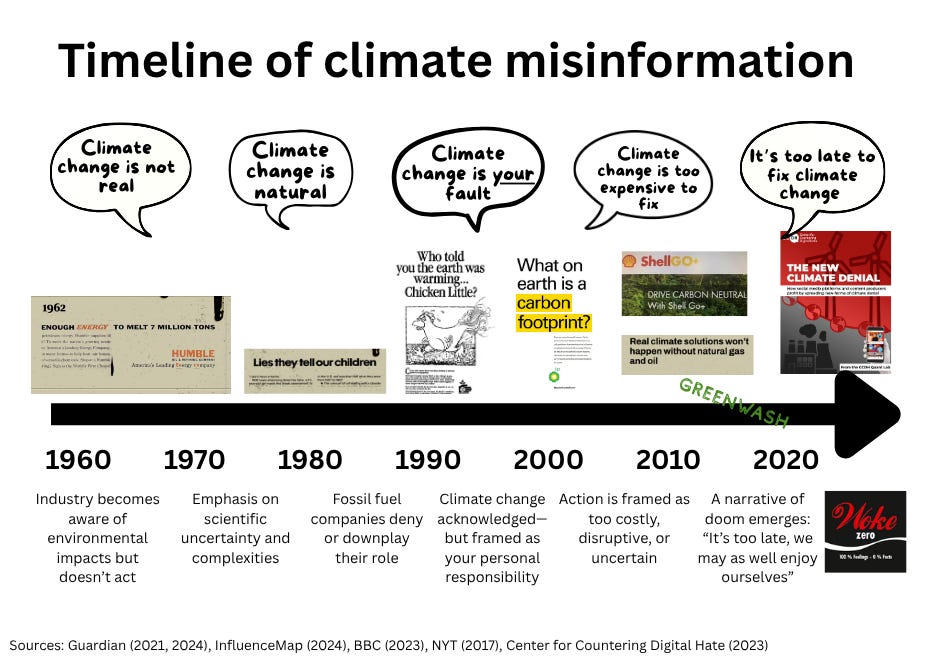
Meanwhile:

Example (continued):
You (using Pathos): “I get it – the messaging’s been a mess and it’s easy to see why ‘keep calm and carry on’ sounds simpler.”
2. Explain (practical benefits)
Now bring in logos. DO NOT DEBATE! Move the conversation away from “climate”, “Net Zero” or whatever set them off; instead, reframe climate action as local, tangible improvements, not abstract ideology10, e.g.
Insulating homes → warmer, cheaper to run, less strain on NHS
Renewable energy → British-made (or natural wind and sun), stable prices, less reliance on imports
Better transport → reliable, affordable ways to get around
Example (continued):
You (using Logos): “But the numbers don’t add up. The point of energy saving measures is to cut bills long term. The average household saves £300–400, and the NHS saves too because fewer people get sick in cold homes. If they’d invested years ago, we’d all be much better off now. The longer they leave it, the more expensive it gets.”
Need receipts? Pick one of these:
The IMF11 and IEA12 say repeatedly, every £1 spent on clean energy now avoids up to £4 in future damages.
In 2023, extreme weather alone is estimated to have added about £192 to the average UK household’s food bill. When combined with energy costs, those two factors raised food bills by an average of £605 per household compared to 2021 - and it’s getting worse.
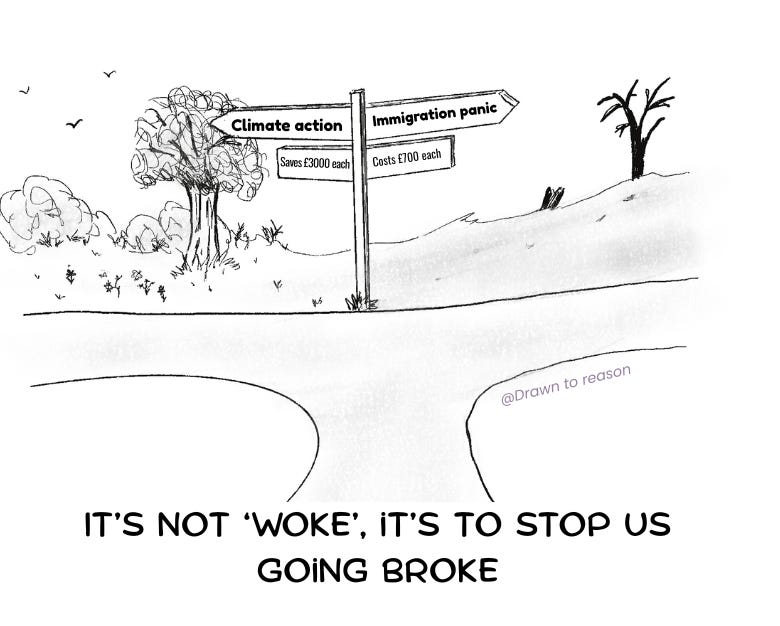
Here are some more ideas:
3. Reassure (optional redirection)
Reassure them that your point(s) play to their values. Bring it back to universal concerns, for example:
Bring it back to the things everyone cares about:
Cost: It’s about keeping bills down. Last year, extreme weather added about £200 to the average family’s food shop — on top of high energy bills. Fixing draughty homes and using clean energy is the cheaper path.
Reliability: It’s about making sure services don’t break when trouble hits. Floods, failed crops and energy price spikes can all happen at once. If we invest in insulation, renewables and strong farming, the NHS won’t get swamped, food will stay on shelves, and families can plan ahead.
Fairness: It’s about making sure ordinary families don’t pay the biggest price while fossil fuel companies make record profits. If you’re going to be cross, be cross about that — not about your neighbour’s recycling bin.
Example (continued):
“So Net Zero isn’t about politics — it’s about being fair and reliable. Why should British families keep paying extra for imported gas, when we could have steady, home-grown energy instead?”
Redirect?
Behavioural science research shows that frustration needs a target — if people aren’t given a clear and justified one, it often gets redirected onto scapegoats13. If they’re angry at “climate action”, they won’t hear the benefits — but if you show who is really driving costs, the anger can be re-anchored (ethos and pathos).
It can help to validate their anger — but point it in the right direction. Anger at immigration or recycling rules is misplaced. Anger at billion-pound fossil fuel subsidies, or corporations lobbying to keep prices high? That’s justified. And channelled right, it aligns with fairness, reliability and protecting ordinary households.
Framing-wise, you’re not just saying “don’t be cross”. You’re saying:
“You’re right to be cross. But the problem isn’t ordinary people or immigrants — it’s that fossil fuel subsidies and corporate lobbying keep us hooked on an expensive system.”
Example (continued):
“If you’re going to be cross, be cross about this:
The politicians are all banging on about immigration, which increases GDP by over 1% (that’s hundreds of pounds each) and keeps the NHS going – all the time trying to distract us from the billions of pounds they’re giving their fossil fuel mates that costs us all thousands.”
Conclusion
So next time your uncle (co-worker or online opponent) sighs about “net zero nonsense”, try starting with what they care about — cost, reliability, fairness and relate that to practical actions that have shorter term, relatable benefits. You might not win the argument, but you’ll keep the door open for conversation, maybe even open their mind a chink.
You won’t change minds over Christmas dinner, but you might keep the peace — and your sanity.
If you’d like more ‘receipts’ to back you up in conversation, here are two explainers I’ve written that dig into the detail…
McAdams, D. P. (2001). The Psychology of Life Stories. Review of General Psychology, 5(2), 100–122.
Stets, J. E., & Burke, P. J. (2000). Identity Theory and Social Identity Theory. Social Psychology Quarterly, 63(3), 224–237.
Aristotle. (2007). On rhetoric: A theory of civic discourse (G. A. Kennedy, Trans., 2nd ed.). Oxford University Press.
Schwartz, S. H. (1992). Universals in the content and structure of values: Theoretical advances and empirical tests in 20 countries. Advances in Experimental Social Psychology, 25, 1–65.
Haidt, J. (2012). The righteous mind: Why good people are divided by politics and religion. New York, NY: Vintage.
Sparks, P., & Shepherd, R. (2020). The impact of identity on climate beliefs and behaviours. Frontiers in Psychology, 11, 1573.
McCright, A. M., & Dunlap, R. E. (2011). Cool dudes: The denial of climate change among conservative white males. Global Environmental Change, 21(4), 1163–1172.
Lynas, M., Houlton, B. Z., & Perry, S. (2021). Greater than 99% consensus on human-caused climate change in the peer-reviewed scientific literature. Environmental Research Letters, 16(11), 114005.
Karimi-Malekabadi, F., Cantu, S. M., Goldberg, M. H., van der Linden, S., Maibach, E., & Leiserowitz, A. (2024). A value-based topography of climate change beliefs and behaviors. PNAS Nexus, 3(2), page 590.
Krause, N. M., & Scheufele, D. A. (2025). Our changing information ecosystem for science and why it matters for effective science communication. Proceedings of the National Academy of Sciences, 122(7),
International Monetary Fund. (2023). IMF fossil fuel subsidies database. Washington, DC: IMF. Retrieved from https://www.imf.org/en/Topics/climate-change/energy-subsidies
(This is the dataset showing global fossil fuel subsidies — ~7 trillion USD in 2022, often cited in climate–economics discussions.)
International Energy Agency. (2023). World energy outlook 2023. Paris: IEA. Retrieved from https://www.iea.org/reports/world-energy-outlook-2023
Nabi, R. L. (2017). Emotion in media persuasion. In J. P. Dillard & L. Shen (Eds.), The International Encyclopedia of Media Effects (pp. 1–11). Wiley-Blackwell.
really helpful article! definitely think I can use these ideas to explain public health topics to those in doubt of public health efforts